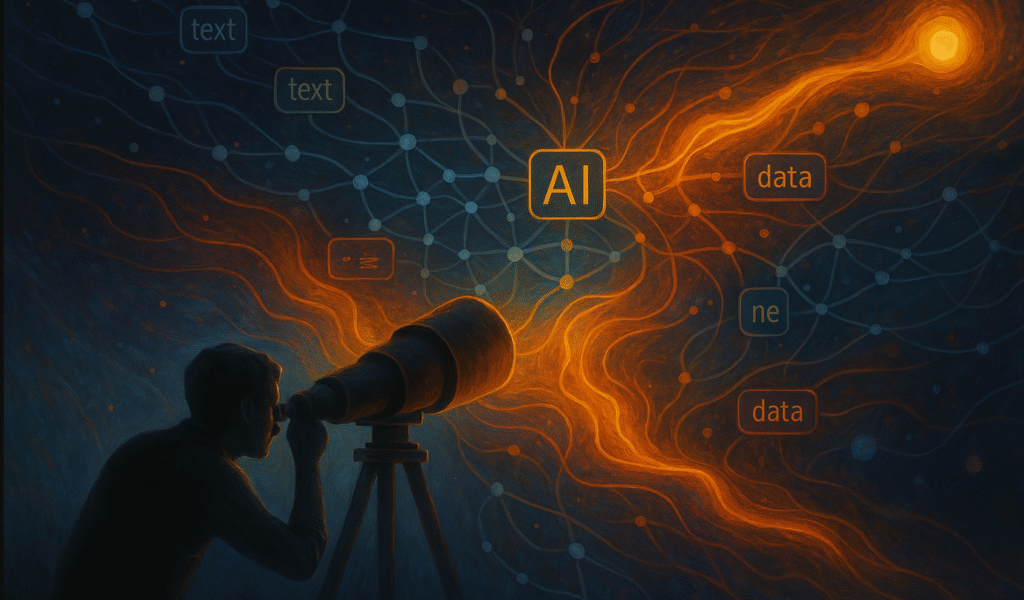
🧠 AI Demystified: From Basics to the Backend
Introduction: Understanding AI.
Artificial Intelligence is everywhere — in your phone, your inbox, even helping write articles like this one. But despite the buzz, AI still feels like a mystery to many: Is it a robot? A brain in a box? Some Silicon Valley sorcery?
This post is here to break it down.
No jargon walls. No PhDs required. Just clear explanations and simple analogies — from what AI is, to how language models like ChatGPT work, to the infrastructure behind it all. Whether you’re a total beginner or already wondering what a “Transformer” is (no, not the robot kind), this guide is for you.
📘 Part 1: AI for Beginners — The Big Picture
❓ What Is AI?
At its core, artificial intelligence refers to software that performs tasks we associate with human-like thinking — such as understanding language, recognizing patterns, solving problems, or learning from data.
But today’s AI doesn’t think or feel. It doesn’t “know” what it’s saying. It’s simply very good at pattern prediction — like guessing the next word in a sentence, the next product you’ll buy, or the best move in a game.
🤖 Common Misconceptions
- “AI is conscious” – False. AI can simulate conversation and creativity, but there’s no awareness or intention.
- “It learns from everyone all the time” – Not quite. Most models don’t learn from your chats unless you explicitly opt into feedback or fine-tuning.
- “It’s like Google” – Not really. Search engines fetch facts; language models generate text based on patterns in massive datasets.
🛠️ How Does It Work?
Imagine reading 10 million books, tweets, blogs, and forum posts — then guessing how people typically finish sentences. That’s what a large language model (LLM) does.
It doesn’t understand meaning like humans do, but it learns the probability of what usually comes next.
Analogy: Think of AI like a supercharged autocomplete. Type “Once upon a…” and it fills in “time” — not because it understands fairy tales, but because that’s what usually follows.
🧠 Part 2: Inside the Language Model
🧱 What Is a Large Language Model (LLM)?
An LLM is a massive neural network trained on oceans of text. Its goal? Predict the most likely next word, given the ones before.
It’s built on a revolutionary design called a Transformer, introduced in 2017 — a major leap in how AI processes language.
🔧 What Is a Transformer?
A Transformer is a type of model architecture that processes sequences — like sentences — all at once, rather than one word at a time.
📚 Analogy: Reading with Super Attention
Imagine reading a paragraph and trying to understand the meaning of a sentence. You don’t just go word-by-word. You pause, reflect, jump back to the start, maybe reread a key phrase.
That’s what a Transformer does — it looks at the whole input, figures out which words matter most, and focuses attention accordingly.
💡 Key Concepts in the Transformer Architecture:
- Self-Attention
The model compares every word to every other word to find relationships.
Example: In “The animal didn’t cross the road because it was too tired,” it learns that “it” refers to “the animal,” not “the road.” - No Recursion or Loops
Older models (like RNNs) read one step at a time. Transformers look at everything at once — making them faster and better at understanding long sentences. - Stacked Layers
Like passing your sentence through a series of experts. Each “layer” looks for different patterns and improves the interpretation. - Token-Based Input
Text is broken into tokens — words or parts of words. These are the puzzle pieces the model uses to construct meaning.
🔑 Important LLM Terms
- Tokens – Units of language (words, subwords, punctuation).
- Embeddings – Numbers representing a token’s meaning and context.
- Attention – A way for the model to decide which words are important.
- Layers – Processing stages that gradually refine the model’s output.
- Parameters – Think of these like billions of “settings” that define how the model behaves — tuned during training, not while chatting with you.
Analogy: Imagine a team of language experts: one tracks grammar, one checks tone, another tracks context. A Transformer coordinates them all at once, not in sequence.
🧮 Language as Math
LLMs don’t understand words — they process numbers.
Each word or token becomes a vector — a set of numbers — and all of these vectors live in a huge mathematical space. Words with similar meanings are “closer together” in that space.
- “Cat” and “kitten”? Nearby.
- “Rocket” and “pineapple”? Far apart.
This allows the model to mimic understanding through math — not emotion, not reason, just statistical proximity.
🔁 How a Response Is Generated
- Your text is split into tokens.
- Tokens become vectors via embeddings.
- The model uses attention layers to process those vectors.
- It predicts the next token — and then the next, and the next.
- The full reply is generated one token at a time.
📈 This process happens in milliseconds — but it’s a lot of math happening very quickly.
🧠 Does AI Use Binary or Fuzzy Logic?
Traditional computers work in binary (on/off, yes/no). LLMs use probabilities.
Each word prediction is more like:
“There’s a 78% chance the next word is ‘cat’, 12% it’s ‘dog’, 3% ‘banana’…”
That’s not fuzzy logic in the classic sense, but it’s non-binary reasoning — closer to intuition than decision trees.
🚫 Limits of LLM Intelligence
- ❌ No true understanding
- ❌ No persistent memory (unless specifically added)
- ❌ Can hallucinate — make up facts
- ✅ Can appear convincing thanks to strong pattern-matching
Still, with the right prompt, an LLM can write poems, debug code, explain philosophy, or summarize Shakespeare. It’s math, not magic — but it’s mighty impressive.
🌐 Part 3: Where AI Lives — Networks, Servers & Data
🛰️ From Prompt to Prediction
When you use ChatGPT, it doesn’t run locally. Your request travels to a remote data center, where powerful GPUs handle the heavy lifting.
🧭 Load Balancing
Before reaching the model, your prompt is routed by a load balancer — kind of like airport traffic control for AI. It sends your request to whichever servers are least busy and closest.
🧮 Distributed Inference
These models are too big to fit on a single chip — even a super-powerful one. So they’re split across many GPUs, which work together.
- One chip may process layers 1–12
- Another handles layers 13–24
- The output is stitched together and sent back to you — fast
🗂️ Where Is the Model Stored?
- Primarily in GPU VRAM — super-fast memory close to the chip
- When demand spikes, new instances are “spun up” (called cold starts), which may take a little longer to respond.
🧠 Does the Model Learn From You?
Not directly. In most cases:
- Your chat doesn’t change the model.
- Some feedback (via thumbs up/down) may be logged to improve future versions.
- Fine-tuning happens offline with curated data, not in real time.
🧯 Filters & Safeguards
LLMs are wrapped in safety systems:
- Prompts are scanned for abuse.
- Harmful outputs are filtered or blocked.
- Sensitive topics may be handled with caution.
These filters aren’t perfect, but they’re essential to avoid misuse.
💸 The Cost of Intelligence
Every query costs compute:
- Each reply uses electricity, bandwidth, and GPU cycles
- Billions of parameters and trillions of math ops may be involved
- That’s why some platforms limit use or charge fees — running a chatbot is not cheap
✅ Conclusion: Now You Know
From guessing words to orchestrating global server farms, modern AI is an extraordinary combo of statistics, software, and silicon — not consciousness, not magic, but brilliant engineering.
You now understand:
✔️ What AI is (and isn’t)
✔️ How language models like ChatGPT work
✔️ Where the model “lives” and how it delivers answers
✔️ Why it’s smart — but not self-aware
So the next time you talk to an AI, you’ll know what’s happening under the hood — from prompt to prediction, from chip to chat.


